
If you’re trying to determine how long it will take to complete a foreclosure in New Jersey, then you are likely searching for answers that aren’t as easy to find. Instead of providing a clear-cut answer to the amount of time required to finalize foreclosure in New Jersey, you’ll likely receive an honest answer from someone who understands foreclosure.
They will tell you that the most difficult aspect of experiencing foreclosure isn’t simply being late. The most difficult aspect of foreclosure is having no idea what is occurring during those times when you are maintaining your regular daily routine.
Many homeowners think nothing has happened if:
* no one has physically removed them.
* mail and correspondence continue to arrive instead of court notice.
* someone hasn’t arrived at their home with a notice.
Foreclosure in New Jersey is a legal proceeding which occurs quietly prior to becoming obvious. Therefore, by the time things appear dire…
They have already appeared dire for some time.
Timeline vs. Intervals Are What Cause Your Losses
Most foreclosures occur over a period of 12-18 months. However, what many individuals fail to explain clearly is how much damage occurs due to the intervals. Not the total number of days, but rather how much time elapses during these intervals. There are intervals of overwhelming reaction followed by stretches of time where there is no activity. Once urgency appears, another interval ensues, until you experience another stretch of time with little activity. These intervals of time are where homeowners experience the greatest loss of progress. Because it may feel like relief…
It is merely the unseen progression of time.
What’s Occurring When You’re Not Watching (behind-the-Scenes activity)
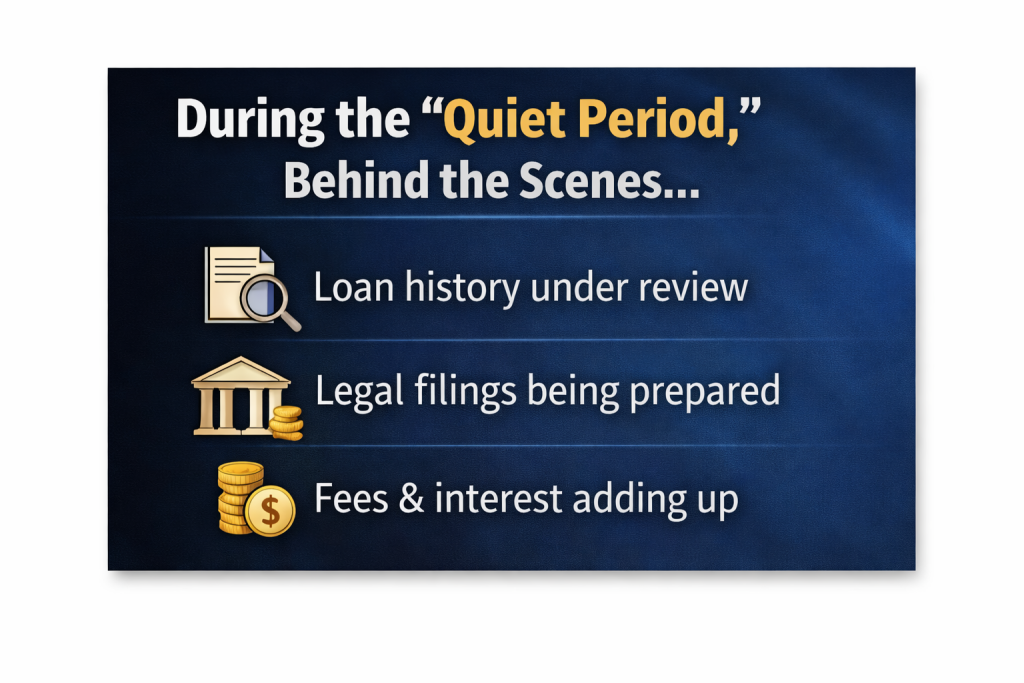
As you go to work, take care of your family and try to make sense of your situation… The lender is:
Analyzing your entire lending history.
Documenting every instance of non-payment and/or communication related to non-payment.
Drafting paperwork that will be submitted to the court.
Adding additional fees/Interest/legal charges to your account.
Once the initial paperwork is submitted to the court, the foreclosure case proceeds independently and does not pause simply because you require time to consider your options.
The Point Where Things Change For All Parties Involved
There exists a precise point within the foreclosure process where everything changes.
That point is when paperwork transforms into action.
At that exact moment in time, most homeowners:
Set documents aside to address later.
Do not open their mail.
Tell themselves they will “take care of it next week.”
Each delay – regardless of size – creates subtle limitations on the number of options available.
Not all at once; however, gradually.
Your capacity for flexibility decreases.
Why Two Individuals Experiencing Similar Situations Are Not Identical
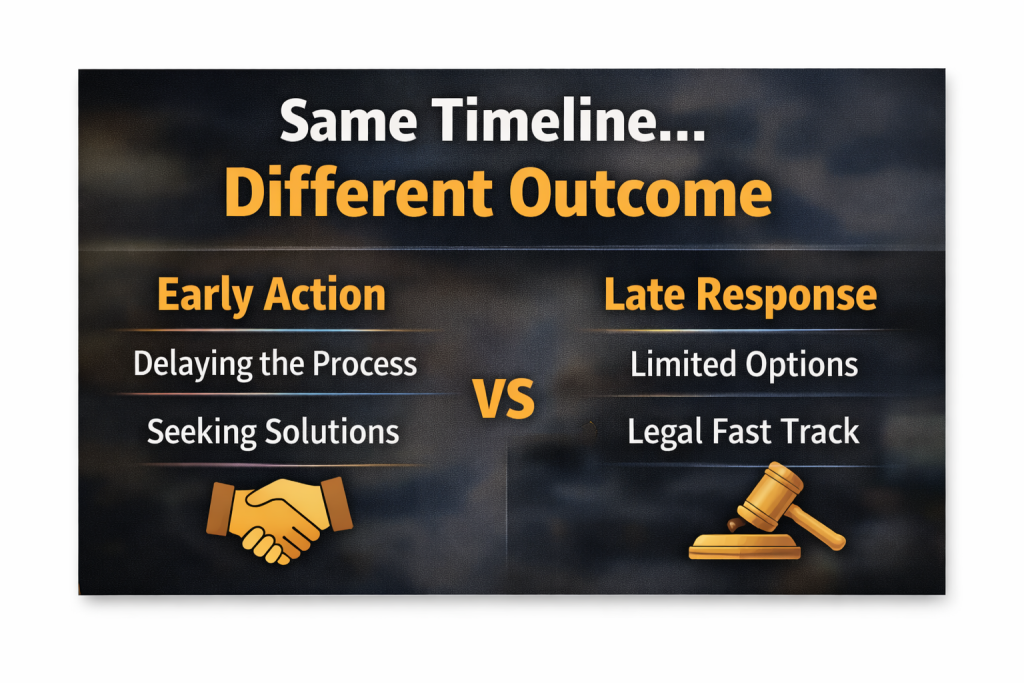
This is perhaps the area most subject to Misunderstanding.
Individuals often report:
“I am only slightly behind.”
“My neighbor was further behind than I was.”
“I still have plenty of time.”
However, foreclosure does not proceed according to how far behind an individual is. Rather, foreclosure progresses based upon what has already occurred legally. As such, Two homeowners can both be “six months behind”.
One homeowner remains capable of negotiating, restructuring or selling strategically.
The second homeowner has advanced significantly into a lengthy foreclosure process which offers less opportunity for slowing down.
Two identical situations documented on paper.
Extremely disparate realities.
Damage incurred by delaying action is incremental
Delaying action initially seems harmless.
Nothing catastrophic happens immediately.
Yet, there exists incremental harm developing in the background:
Additional fees accumulating monthly due to delinquency;
Legal expenses incurred once the case is formally initiated;
Continuing accumulation of Interest;
Lost opportunities to act sooner, and therefore enjoy greater breadth in options available;
Additionally, time transitions from serving you positively…to acting negatively.
The Real Question To Ask Yourself
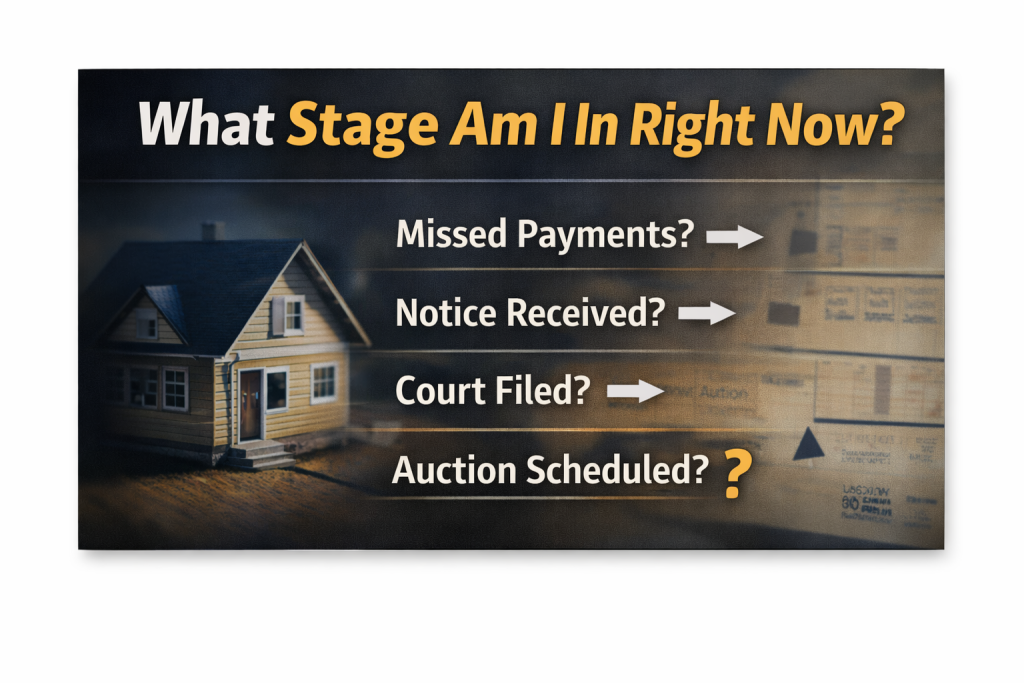
Rather than questioning: “how long does foreclosure take?” Ask yourself:
“What stage am I currently at within the foreclosure process, and what does that enable me to accomplish presently?”
Since answering that query establishes everything:
Whether you possess influence;
Whether you retain control;
Whether you react… Or continue making choices on your own terms.
View the Video — next return here
Below is a link to a Video explaining the true New Jersey foreclosure Timeline step-by-step so that you may observe precisely how this develops and where each stage commences.
👉 click here to view Then return to this page and view this content again.
After you have understood the framework of the Timeline, this will resonate with you distinctly, and you will begin to comprehend where you truly stand in relation to your present situation.
Final Note
You are under no obligation to panic; however, you should also avoid remaining in a state of perpetual uncertainty (“tomorrow”). Because foreclosure does not seize everything simultaneously…It seizes it incrementally, while it still appears you have ample time.
Therefore, comprehending your current standing within the context of foreclosure is infinitely more critical than the duration of foreclosure itself. If you’re still trying to figure this out on your own, you’re already losing time. And in this process, time is everything.
👉 Grab a time on my calendar — let’s figure out exactly where you stand before things move any further.
Disclaimer: This content is for informational purposes only and should not be considered legal or financial advice. Every foreclosure case is different, and timelines can vary based on individual circumstances. Always consult with a qualified attorney or financial professional to understand your specific situation before taking action.
FAQ’s
How long does the average Foreclosure take to complete in New Jersey?
On average, a Foreclosure in New Jersey can take anywhere from 12 – 18 months to complete; however, timelines for completing a Foreclosure will vary depending upon several factors including how quickly the lender acts, whether you comply with any legal notifications that are received, as well as whether mediation or delays occur during the Foreclosure process.
How soon will Foreclosure begin in New Jersey?
Foreclosure does not commence automatically when you stop making payments on your mortgage. Prior to commencing a Foreclosure action, lenders must first wait at least 120 days prior to filing their Foreclosure complaint. Additionally, they must provide you with written Notice, known as a Notice of intent to foreclose (NOI), no less than thirty (30) days prior to taking any further action.
What is a Notice of intent to foreclose (NOI)?
A Notice of intent to foreclose (NOI) is a formal written Notice provided by the lender prior to filing a Foreclosure lawsuit against you. The NOI provides detailed information regarding how much money you need to pay to bring the loan up-to-date and provides a time frame within which you may act prior to the case entering into litigation.
How much time do you have after being served with Foreclosure papers in NJ?
After receiving service of a Foreclosure complaint, you generally have 35 days to file an answer. Failure to timely respond to the complaint may result in the lender obtaining a default judgment, thereby expediting their efforts to obtain possession of your home through other means.
Can Foreclosure be delayed in New Jersey?
Yes. Through various methods such as responding to the complaint filed against you, participating in mediation, or finding errors made by the lender, among others, you can delay the Foreclosure proceeding. Depending on the status of the case, there may be statutory provisions available that permit temporary stays of the proceeding.
Is it too late to stop foreclosure once a sheriff sale has been scheduled in NJ?
No. Although scheduling a sheriff’s sale is an indication that your lender is moving closer to gaining title to your home, it is not always too late. In New Jersey, you may still be able to request adjournments of the sheriff sale, and in certain circumstances, continue pursuing your rights even after the sheriff sale occurs.


 EN
EN
 RU
RU